Handmade in Bahawalpur: The Complete Guide to Our Gota, Chunri, Ajrak, Khussa & Kundan Collection
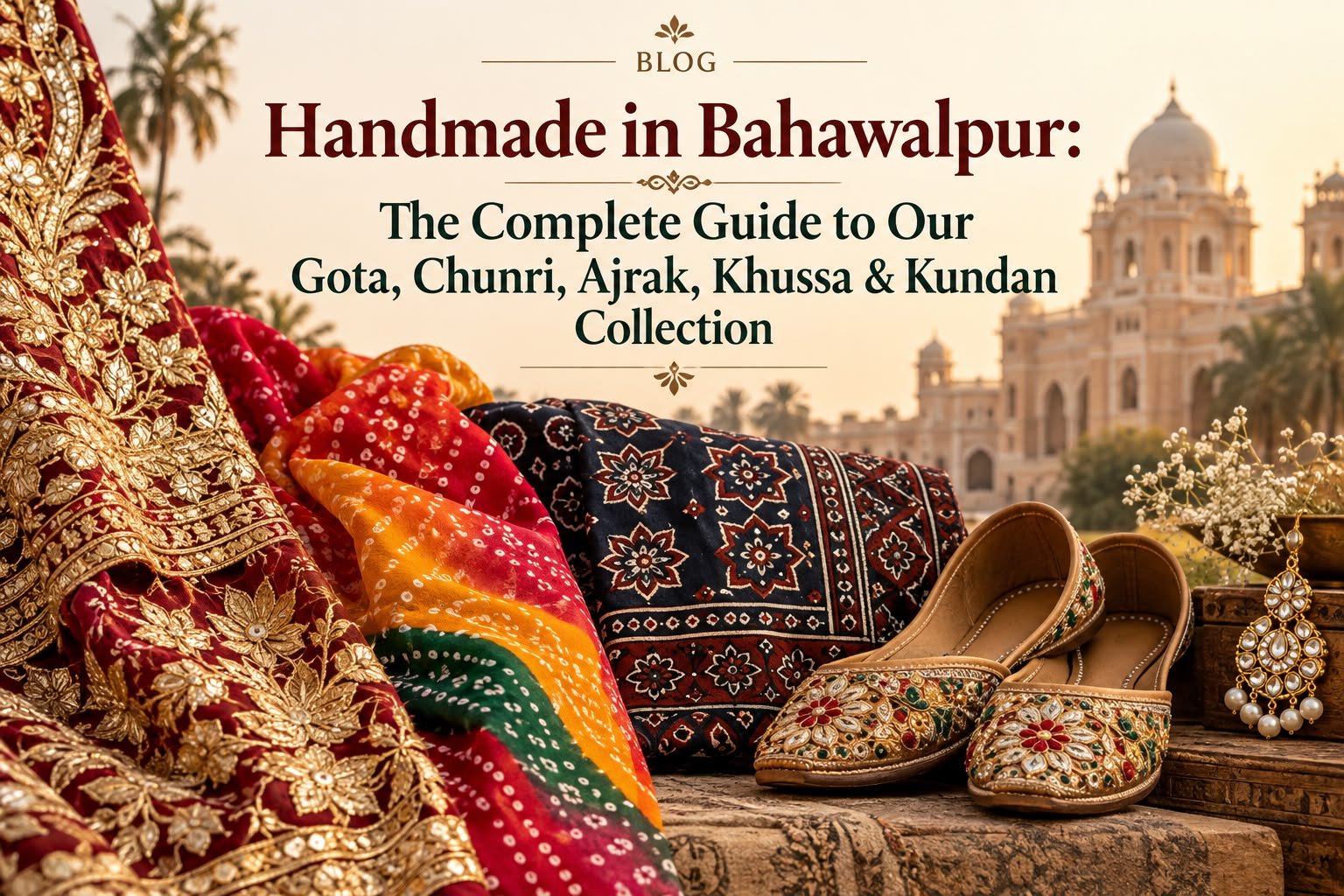
Handmade in Bahawalpur: The Complete Guide to Our Gota, Chunri, Ajrak, Khussa & Kundan Collection
Some things cannot be rushed. A chunri dupatta holds thousands of tiny knots, each pinched and tied by hand. A gota suit is built leaf by shimmering leaf. A pair of khussa is cut, stitched and shaped on a wooden mould. In Bahawalpur, this patient work is not a passing trend. It is a way of life, handed down from mother to daughter and from master to apprentice for generations.
At Gota Kinari, we are bringing that heritage to your wardrobe and your home. Our new collection is made entirely by hand in Bahawalpur and covers eleven of the region’s most loved crafts: gota suits, press gota suits, block print suits, mukesh work, hand-embroidered suits, ajrak suits, hand-embroidered dupattas, chunri, khussa, kundan jewellery and block print bedsheets.
In this guide, you will learn what each piece is, how it is made, what makes a handmade piece from Bahawalpur special, and how to wear and care for it, so you can choose with confidence.
Why Bahawalpur? A City Built on Craft
Founded in 1748, Bahawalpur was the capital of a princely state ruled by the Abbasi Nawabs until 1955. Their palaces, such as the Italian-style Noor Mahal built in 1872, still speak of a court that valued beauty and fine craftsmanship. Just beyond the city lies the Cholistan desert, whose people are known for bright, joyful colours that stand in bold contrast to the sand around them.
That meeting of royal taste and desert colour shaped a remarkable craft culture. Researchers at the Islamia University of Bahawalpur describe chunri as the city’s most popular handicraft, loved across Pakistan and even exported, and the khussa as Bahawalpur’s specific identity. Embroidery and mukesh work on clothes and dupattas rank among the leading home crafts of the region, and Bahawalpur is one of the few centres of hand block printing in the country.
Much of this work still happens at home. In villages such as Abbas Nagar, near Bahawalpur, the large majority of residents are involved in craft-making, and women are the backbone of chunri making and embroidery. One veteran chunri maker from Cholistan told Dawn that she learned the craft from her mother at the age of five.
That is exactly why our collection comes from Bahawalpur: the skill here is inherited, not learned from a machine manual. And because every piece is made by hand, no two pieces are ever exactly alike.
The Collection at a Glance
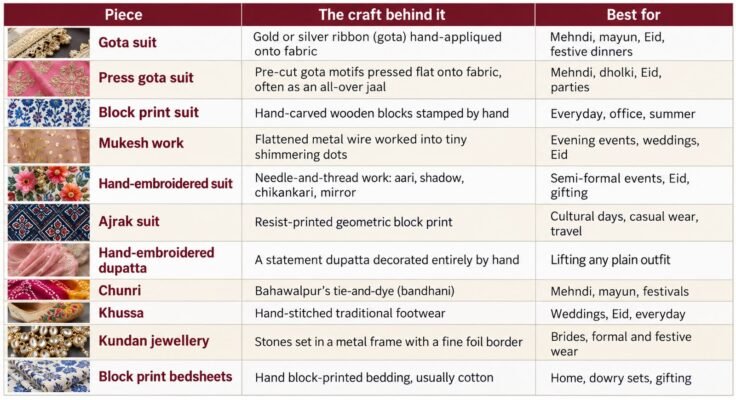
Here is a quick overview of the eleven handmade pieces in our Bahawalpur collection.
1. Gota Suits: Bahawalpur’s Festive Favourite
What is a gota suit?
A gota suit is a shalwar kameez or two-piece outfit decorated with gota, a gold or silver ribbon that is cut, folded into leaves, flowers and borders, and stitched onto the fabric by hand. It looks rich under the lights yet stays surprisingly light to wear.
Gota is the very craft our name celebrates. The word refers to a woven metallic ribbon: when it runs along an edge it is called gota kinari, and when it is cut into motifs it becomes gota patti (patti means leaf). The craft flourished in the royal courts of the region, where the ribbon was once woven with real gold and silver. Over time it moved to silver-coated copper, and much of today’s gota is made from a metallised film that resists moisture and does not tarnish, which helps it stay bright for years.
How it’s made: The artisan traces the design onto the fabric with a chalk paste and stretches the cloth on a wooden frame called an adda. Strips of gota are cut and folded into leaves, petals, triangles and borders, then hemmed or back-stitched into place one piece at a time. In traditional workshops, the finished work is gently tapped with a small wooden mallet so every piece lies flat and polished. A dense dupatta border alone can take days.
Why ours is special: In Bahawalpur, gota is a household art. A newspaper feature on Bahawalpur’s embroiderers profiled a local artisan who had been doing gota work for 25 years, and that kind of experience shows in the details: crisp folds, even stitches and motifs that sit flat. Because each leaf is placed by hand, your suit will carry small variations that no machine can copy.
How to wear it: Gota is the heart of mehndi and mayun dressing, especially in yellow, green, orange and pink. A lighter gota border on a pastel suit is perfect for Eid or a family dinner. Keep jewellery simple when the gota is heavy, or add kundan jhumkay for a complete festive look.
Best for: Mehndi, mayun, dholki, Eid and festive dinners.
Care tip: Dry clean, or hand wash gently in cold water without wringing. Iron on the reverse with a pressing cloth, and store folded in cotton or muslin rather than plastic.
2. Press Gota Suits: Crisp Shine, Lighter Feel
What is press gota?
Press gota, also called pasting gota, is a style of gota work in which small pre-cut gota motifs are set along a traced design and pressed firmly so they bond flat to the fabric. It makes dense, all-over jaal patterns possible, gives a crisp, mirror-like shine, and is usually lighter and more affordable than fully hand-hemmed gota.
If traditional gota is about raised, folded texture, press gota is about crisp, flat sparkle. Artisans in Bahawalpur and Multan use it to cover an entire shirt and dupatta in a fine jaal (net) of tiny shapes, a look that would take many times longer if every piece were hemmed individually.
How it’s made: The design is traced first, just as with regular gota. The artisan then places tiny cut shapes, such as dots, diamonds, leaves and stars, along the lines and presses them into place so they lie perfectly flat. Many pieces are finished with thread outlines, sequins or small stones for added depth. Newer high-shine versions, often sold as LCD or LED gota, use an extra-reflective film.
Why ours is special: Press gota is only as good as the hand that places it. Wobbly lines and lifting edges are the giveaways of rushed work. In our pieces, the jaal runs evenly across the fabric, the edges sit flat, and the pattern flows neatly from shirt to dupatta. It looks festive from across the room yet feels light enough to wear all evening.
How to wear it: Press gota on soft chiffon is a go-to for mehndi guests, dholkis and Eid. Choose a full-jaal suit when you want the outfit to do the talking, or wear a press gota dupatta over a plain suit for sparkle without the weight.
3. Block Print Suits: Everyday Wear with Centuries of Story
What is a block print suit?
A block print suit is printed by hand with carved wooden blocks. The printer dips each block in colour and stamps it onto the fabric again and again, lining up every impression by eye to build the pattern. The result is a breathable, everyday suit with the character of real handwork.
Block printing is one of the oldest ways of decorating cloth in the Indus region. South Punjab has kept the tradition alive, with Bahawalpur, Multan and Kahror Pakka among its surviving centres. The Bahawalpur Museum even preserves old block-printed textiles, including a cotton cloth printed with calligraphy.
How it’s made: Everything starts with the block. Craftsmen carve the design into hard wood such as sheesham or teak using a mallet and chisel, and a single detailed block can take days to finish. The fabric is washed to remove its starch and pinned flat on a padded table. The printer stamps an outline block first, then filler blocks for each colour, aligning every impression by eye. Traditional printers draw their colours from natural sources, and some designs use a mud-resist paste called dabu to keep areas free of dye.
Why ours is special: Look closely at a hand block print and you will see tiny shifts in colour and alignment where one stamp meets the next. That is not a flaw; it is proof that a person, not a rotary machine, made your suit. Our block print suits come from Bahawalpur’s own printing tradition, so you get the soul of handwork in a piece you can wear every day.
How to wear it: Block prints shine on cotton and lawn, ideal for long Pakistani summers, office days and relaxed weekends. Pair a busy print with a plain dupatta, or a subtle print with a hand-embroidered dupatta for an instant upgrade.
Best for: Everyday wear, office, summer and travel.
Care tip: For the first few washes, wash separately in cold water with a mild detergent, as hand-printed colours can release a little dye. Dry in the shade and iron on the reverse.
4. Mukesh (Mukaish) Work: The Quiet Shimmer of Metal on Cloth
What is mukesh work?
Mukesh, also written mukaish and known as badla work, is embroidery made with a thin, flattened metal wire. The artisan passes the wire through the fabric with a fine needle, twists it and clips it, leaving tiny metallic dots or short rods that catch the light like scattered stars.
Mukesh is believed to have travelled to the subcontinent with the Mughals, who had it worked in real gold and silver, and it became famous in Lucknow. Bahawalpur, another city of Nawabs, made it its own. Researchers at the Islamia University of Bahawalpur list mukesh work on clothes and dupattas among the region’s leading home crafts, and local artisans have developed their own variations, such as the rice-grain style known locally as chawal.
How it’s made: Unlike most embroidery, mukesh uses no thread. The flat wire, called badla, goes in and out of the fabric itself. For fardi (dot) work, the artisan makes a tiny stitch, twists the wire tight and snips it to leave a single dot. Thousands of these dots come together as borders, floral motifs and all-over jaals. There is so much metal in the work that Bahawalpur’s artisans have traditionally priced it by weight.
Why ours is special: Hand mukesh has a depth and gentle irregularity that machine imitations cannot match: each dot sits slightly differently and throws the light in its own direction. Every mukesh piece in our collection is worked by hand in Bahawalpur, from a delicate sprinkle of dots to a dense, bridal-style jaal.
How to wear it: Mukesh is at its best on sheer, fluid fabrics such as chiffon and crinkle chiffon. A light dotted suit is elegant for evening events and Eid, while a heavy jaal suit or dupatta is made for weddings. Mukesh also pairs beautifully with chikankari and chunri.
Best for: Evening events, weddings, Eid and formal dinners.
Care tip: Dry clean where possible. Store folded with a layer of tissue or muslin so the metal does not snag other fabrics, and keep it away from damp to prevent dulling.
5. Hand-Embroidered Suits: Stitch by Stitch, Home by Home
What makes a suit hand-embroidered?
A hand-embroidered suit is decorated entirely with needle and thread by an artisan rather than an embroidery machine. In Bahawalpur, that includes aari work, shadow work, chikankari, mirror work, cross-stitch and Kashmiri tanka, often combined on a single piece.
Embroidery is the craft that connects Bahawalpur’s homes. For generations, women across the former Bahawalpur State have embroidered from home, and the city has long been known for high-quality needlework. Alongside chunri, aari work is regarded as one of Bahawalpur’s local specialities.
The stitches you will find
⦁ Aari work: The fabric is stretched on a wooden frame and worked with a fine hooked needle, creating flowing chain-stitch lines and fillings.
⦁ Shadow work: The embroidery is done on the back of a sheer fabric, so a soft shadow of colour shows through on the front.
⦁ Chikankari: Fine, often tone-on-tone embroidery. It began in Lucknow, but research on South Punjab’s needlework notes that Bahawalpur’s Nawabs and elites were major patrons of chikankari, and local artisans keep it alive today.
⦁ Mirror (sheesha) work: Tiny mirrors held in place with dense buttonhole-style stitching. A heavily worked kameez and dupatta can carry well over a thousand mirrors.
⦁ Cross-stitch and Kashmiri tanka: Neat, colourful geometric and floral stitching, much loved for semi-formal wear.
Why ours is special: A machine repeats; a hand interprets. Turn a hand-embroidered piece inside out and you will see small knots and thread paths that show a person made it. Our hand-embroidered suits are stitched by artisans in Bahawalpur, and because each piece takes days of work, every suit has its own quiet personality.
How to wear it: Hand-embroidered suits are the most versatile pieces in the collection: dressy enough for Eid and family functions, refined enough for work events. Choose white-on-white chikankari for summer elegance, or colourful cross-stitch and mirror work for festive days.
Best for: Eid, family functions, semi-formal events and gifting.
Care tip: Hand wash gently in cold water or dry clean. Iron on the reverse over a folded towel so the stitches keep their raised texture.
6. Ajrak Suits: The Indus Valley’s Most Famous Print
What is ajrak?
Ajrak is a traditional hand block-printed textile of the Indus region, known for deep indigo blue and crimson red with black and white geometric patterns. It is made through repeated stages of resist printing and dyeing. An ajrak suit brings this print into a shirt, a dupatta or a complete outfit.
Ajrak is one of Pakistan’s most recognisable textiles. Its roots lie in Sindh, and the tradition is often traced back some 5,000 years to the Indus Valley. But ajrak belongs to the whole Indus basin. In the Saraiki belt of South Punjab, which includes Multan, Bahawalpur and the Cholistan region, ajrak is part of everyday culture, and the people of Cholistan have long been known for ajrak among their handicrafts. Every year on 6 March, Saraiki Culture Day, also known as Saraiki Ajrak Day, people across South Punjab wear blue ajrak with pride.
How it’s made: Authentic ajrak is a slow, multi-stage craft. The cloth is washed and prepared, then printed with carved blocks using resist pastes made from ingredients such as clay, lime, gum and alum. It is dyed in indigo, dried, washed and dyed again, often with madder for the reds, so that each colour appears only where the design needs it. Many ajraks are printed on both sides with perfectly matched blocks, and the full process can stretch over days or even weeks.
Why ours is special: Printed imitations of ajrak are everywhere; hand block-printed ajrak is not. Our ajrak suits are block printed by hand in Bahawalpur, so the motifs have the depth, sharp symmetry and gentle variation that only wooden blocks can create.
How to wear it: Ajrak suits are wonderful for casual days, university, travel and cultural events. Pair an ajrak shirt with a plain white or black shalwar, or wear a plain suit with an ajrak dupatta for a modern, balanced look. On Saraiki Culture Day, blue ajrak is the natural choice.
Best for: Cultural days, casual wear, travel and university.
Care tip: Hand-dyed colours may bleed at first. Wash separately in cold water, avoid long soaking, and dry in the shade to keep the indigo deep.
7. Hand-Embroidered Dupattas: The Piece That Makes the Outfit
What is a hand-embroidered dupatta?
A hand-embroidered dupatta is decorated entirely by hand, using techniques such as mukesh, gota, aari, shadow work, cross-stitch or mirror work. Because the dupatta is the most visible part of a Pakistani outfit, a handmade one can transform even the simplest plain suit.
In Pakistani dressing, the dupatta is never an afterthought. It frames the face, falls across the shoulders and is the first thing people notice. That is why Bahawalpur’s artisans often save their finest work for dupattas: full gota borders, scattered mukesh, delicate shadow work, or a jaal that runs from end to end.
How it’s made: Most embroidered dupattas are worked on light, flowing fabrics such as chiffon, crinkle chiffon, organza or silk, stretched on a frame so the stitches stay even. The borders usually come first, then the pallu (end panels), and finally any all-over motifs. A heavily worked dupatta can take longer to make than the rest of the suit.
A Bahawalpur tradition: Many hand-embroidered pieces from Bahawalpur are traditionally made on white or light fabric so they can be dyed later to match an outfit. If you need a specific colour match, message us and we will tell you what is possible.
Why ours is special: Our dupattas are embroidered by hand in Bahawalpur, so the work holds up both up close and from across the room. No two borders are identical, which makes a handmade dupatta a thoughtful gift for mothers, sisters, brides and family overseas.
How to wear it: Style a heavily worked dupatta over a plain suit in a matching or contrasting colour and let it be the centrepiece. Drape it over one shoulder for formal events, or across both shoulders to show off the full border.
Best for: Upgrading plain suits, Eid, weddings and gifting.
Care tip: Store rolled or loosely folded in a cloth bag, avoid hanging heavy embroidery on a thin hanger for long periods, and dry clean pieces with metal work.
8. Chunri: Bahawalpur’s Signature Tie-and-Dye
What is chunri?
Chunri is Pakistan's name for the ancient tie-and-dye craft known elsewhere as bandhani. Tiny points of fabric are pinched and tightly tied with thread before dyeing, so they resist the colour. When the knots are opened, they reveal patterns of small dots. Bahawalpur's chunri is among the most celebrated in Pakistan.
If one craft could stand for Bahawalpur, it would be chunri. Researchers at the Islamia University of Bahawalpur call it the city’s most popular handicraft: worn by women of every age, sent as gifts to other cities and abroad, and exported. It is a centuries-old craft, and much of it is still made by women at home, in villages such as Abbas Nagar and across Cholistan.
How chunri is made the Bahawalpur way
1. White cloth is folded: cotton into four layers, silkier fabrics into two.
2. The women sketch the design freehand with a pencil.
3. The design is marked with needle and cotton thread, doubled over many times for strength, and the fabric is gathered and tied.
4. The cloth is shaped into a small bundle, and its tied tips are dipped in two or three colours. These colour marks, about one to two inches long, are known locally as chaun.
5. The cloth is tied again, and the areas meant to become borders are wrapped in plastic and bound tightly.
6. The cloth goes into the base-colour dye bath, then is rinsed and dried. In winter, it is sometimes spread on sand to dry faster.
7. Finally, the threads are untied to reveal the pattern.
Chunri was once coloured with natural dyes known locally as matka colours. Today artisans work with a wider palette, and designs have moved beyond dark shades to soft pastels too. You will find chunri on cotton, lawn, linen, crepe, crinkle chiffon and silk.
Why ours is special: Hand-tied chunri has slightly irregular dots and soft blooms of colour around every knot, a texture that printed chunri-effect fabric can only imitate. Our chunri is made in Bahawalpur, where the craft has been handed down for generations.
How to wear it: Red-and-white or multicolour chunri is a mehndi and mayun classic, and a chunri dupatta over a plain suit is one of the easiest ways to look festive. Lighter, softer chunri is lovely for everyday summer wear.
Best for: Mehndi, mayun, Eid, festivals and summer.
Care tip: Wash separately in cold water for the first few washes, do not soak or wring, and dry in the shade. If your chunri has a crinkled texture, steam it lightly rather than pressing it flat.
9. Khussa: Bahawalpur’s Hand-Stitched Signature
What is a khussa?
A khussa is a traditional South Asian slip-on shoe with a pointed, often curled toe, hand-stitched from leather and decorated with tilla (metallic thread), dabka, sequins, beads or embroidery. Bahawalpur is one of Pakistan's best-known khussa-making centres.
Khussas have been worn in this region for centuries. In the Mughal courts they became Saleem Shahi shoes, by popular account named after Emperor Jahangir, who was known as Prince Salim before he came to the throne. They were embroidered with gold and silver thread and even set with gems. In Bahawalpur, khussa-making is a family trade: researchers call the khussa the city’s specific identity and note that a number of local families are associated with the craft.
How it’s made: The classic Bahawalpuri khussa is made from leather, traditionally brought from the tanneries of Multan. The upper is cut around a hardboard template called the andaza, lined with cloth fixed with a flour-based paste, and stitched to a layered leather sole with an awl (aar) and needle. The shoe is then fitted onto a wooden mould called a sancha and shaped with a wooden hammer, a step known as thappai. Finally comes the embellishment: tilla embroidery, dabka, sitara (sequins), moti (beads) and more.
Why ours is special: Every pair in our collection is cut, stitched and finished by hand in Bahawalpur. Hand stitching gives a khussa its flexibility, and traditionally made khussas often have no strict left or right, so the leather gradually shapes itself to your feet.
How to wear it: Khussas go with almost everything: shalwar kameez, lehenga, sherwani, kurta pajama, even jeans. Choose tilla or heavily embellished pairs for weddings and Eid, and simpler pairs for everyday wear. Khussas are worn by women, men and children alike.
Fit tip: A new khussa should feel snug across the top of the foot, but never painful. Wear it around the house for short periods over a few days, and it will soften and mould to your feet.
Best for: Weddings, Eid, festive wear and everyday style.
Care tip: Keep khussas away from water, store them stuffed with soft paper in a cloth bag, and wipe embellishments with a soft, dry cloth.
10. Kundan Jewellery: Royal Sparkle, Handmade in Bahawalpur
What is kundan jewellery?
Kundan is a traditional jewellery technique in which stones are set into a metal frame and held in place by a fine foil border instead of prongs, giving each stone a smooth, glowing outline. Kundan sets are often finished with pearls, beads and colourful meenakari (enamel) on the reverse.
Kundan traces its grandeur to the Mughal courts, where master setters perfected the art of fixing gemstones in pure gold foil. It remains the look of choice for brides and wedding guests across Pakistan, and Bahawalpur has a well-known handmade kundan trade, with local makers crafting chokers, necklaces, jhumkay, teekas and matha pattis.
How it’s made: Each piece starts as a hand-shaped metal frame with small cavities for the stones. The cavities are filled with a base of lac (a natural resin), the stones are placed, and fine foil is pressed tightly around each one until it holds. Many pieces are finished with meenakari on the back, then polished, before pearls or bead drops are added.
Kundan today: Heirloom kundan is made with precious stones set in gold. Many bridal and festive kundan sets today are handmade fashion jewellery, with glass or crystal stones in a plated metal frame, which gives the same royal look at a fraction of the cost. If you would like to know the exact materials used in any set, just ask us.
Why ours is special: Our kundan jewellery is handmade in Bahawalpur, so every stone is set by hand. Look for clean, even borders around each stone and neat finishing on the back: the signs of careful work.
How to wear it: A kundan choker with matching jhumkay suits gota, mukesh and chunri outfits perfectly. Brides can add a teeka or matha patti for the mehndi, while for guests a single statement piece is usually enough.
Best for: Brides, wedding guests, Eid and formal events.
Care tip: Keep kundan away from water, perfume and moisture. Wipe it with a soft, dry cloth after wearing and store each piece separately in an airtight pouch or box.
11. Block Print Bedsheets: Bring Bahawalpur Home
What is a block print bedsheet?
A block print bedsheet is bedding printed by hand with carved wooden blocks, usually on cotton. Each repeat of the pattern is stamped individually, so the finished sheet has the depth and small variations of true handwork, and it grows softer with every wash.
Bahawalpur has long been one of the few centres of hand block printing in Pakistan, and over time bedspreads and dastarkhwans (dining cloths) became the classic products of its printers. Foreign visitors to cities such as Lahore, Multan, Bahawalpur and Islamabad also used to buy block-printed bed covers from handicraft shops as souvenirs.
How it’s made: The same patient process used for block print suits is applied on a larger canvas. A large bedsheet can take hundreds of individual stamps, each aligned by eye, with separate blocks for outlines, fillings and borders. When a set includes pillow covers, they are printed with the same blocks so everything matches.
Why ours is special: Our block print bedsheets are hand printed in Bahawalpur. Cotton block prints breathe well in hot Pakistani summers and soften with use, and the gentle variations across the sheet make a bedroom feel crafted rather than mass-produced.
How to use them: Choose earthy reds, indigos and mustards for a traditional look, or soft florals for a calm, modern bedroom. Block print bedsheets also make meaningful additions to a dowry (jahez) and thoughtful housewarming gifts.
Best for: Everyday bedding, guest rooms, dowry sets and gifting.
Care tip: Wash separately in cold water the first few times, use a mild detergent without bleach, dry in the shade, and iron on the reverse while slightly damp.
How to Tell Genuine Handmade Work
Machine-made copies of these crafts are everywhere. Here is how to recognise the real thing:
⦁ Check the back. Hand embroidery shows small knots and slightly uneven thread paths, while machine embroidery looks perfectly uniform and is often backed with a mesh.
⦁ Look for tiny variations. Small differences in dot size (chunri), stamp alignment (block print and ajrak) and motif spacing (gota) are signs of handwork.
⦁ Inspect the edges. In good gota and press gota, every edge lies flat and secure.
⦁ Feel the weight. Real mukesh has a cool, metallic weight that printed shimmer does not.
⦁ Ask where it was made. Every piece in this collection is handmade in Bahawalpur.
Care at a Glance
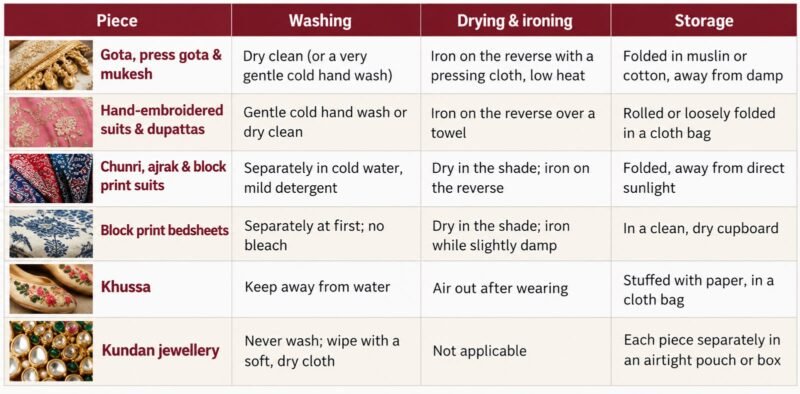
Handmade pieces last for years with a little care. Here is a quick reference for the whole collection.
Which Piece for Which Occasion?
Not sure where to start? Here are our picks for the moments that matter.
FINAL PICK
Mehndi & Mayun
A gota or press gota suit in yellow, green or orange, a chunri dupatta, kundan jhumkay and a tilla khussa.
FINAL PICK
Wedding Guest (Barat & Walima)
A mukesh or heavy press gota suit with a kundan choker and an embellished khussa.
FINAL PICK
Eid
A hand-embroidered suit or a light gota suit, finished with a matching khussa.
FINAL PICK
Everyday & Office
Block print or ajrak suits in cotton or lawn, lifted with a simple hand-embroidered dupatta.
FINAL PICK
Gifting, Especially for Family Abroad
A hand-embroidered dupatta, a chunri dupatta or a kundan set: light to pack and unmistakably Bahawalpuri.
FINAL PICK
Home & Dowry
Block print bedsheets in traditional reds, indigos and mustards.
Frequently Asked Questions
Are the pieces in Gota Kinari’s Bahawalpur collection really handmade?
Yes. Every piece in this collection is made by hand by artisans in Bahawalpur, whether it is tied, stitched, printed or set. That is also why each piece is unique.
Why does my piece look slightly different from the photo?
Handwork naturally varies: dots, stitches and block impressions are never perfectly identical, and screen settings can also shift how colours look. These small differences are the signature of handmade work, not defects.
What is the difference between gota and press gota?
Traditional gota is cut, folded and hand-stitched onto the fabric, giving a raised texture. Press gota uses small motifs pressed flat onto the fabric, often in an all-over jaal, for a crisp shine with less weight.
What is the difference between mukesh and gota?
Gota is a woven metallic ribbon cut into shapes and applied to the fabric. Mukesh is a flattened metal wire worked into the fabric as tiny dots or rods. Gota looks bold; mukesh looks delicate and starry.
Is chunri the same as bandhani or tie-dye?
Yes. Chunri is the Pakistani name for the bandhani tie-and-dye craft, and Bahawalpur’s chunri is among the best known in the country.
Will ajrak, chunri or block print colours bleed?
Hand-dyed and hand-printed fabrics can release some colour in the first few washes. Wash them separately in cold water and dry them in the shade.
How should a new khussa fit?
Snug across the top of the foot, but never painful. The leather softens and moulds to your feet within a few wears.
Wear a Piece of Bahawalpur
Bahawalpur’s crafts have survived for centuries because families refused to let them go. Mothers still teach daughters to tie chunri knots, khussa makers still pass their tools to the next generation, and printers still guard blocks carved long before their time. When you choose a handmade piece, you help keep that chain unbroken.
Explore the Gota Kinari Bahawalpur collection, from gota and press gota suits to block print and ajrak suits, mukesh and hand-embroidered pieces, dupattas, chunri, khussa, kundan jewellery and block print bedsheets, and find something no one else will be wearing. Have a question about a colour, size or piece? Message us on WhatsApp and our team will be happy to help.